
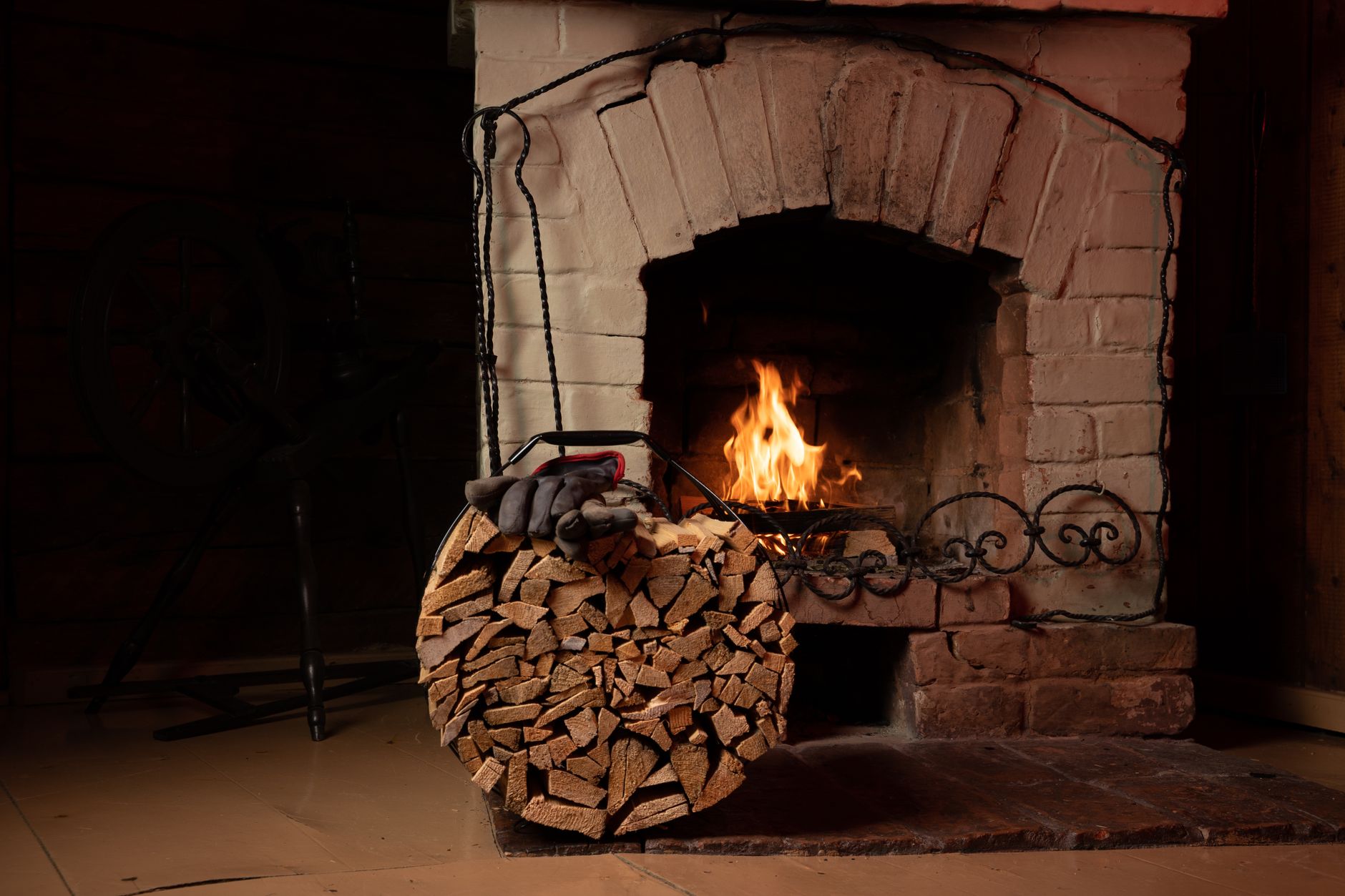
Gas Logs Fitted to a Firebox We Have Measured and Written Down
Book Gas Logs
Name the street and the reason you are getting in touch. We write back with the visit details, the price where one is published, and who receives the paperwork.
What the Visit Records
Gas logs suit an open fireplace you want to keep as a fireplace. Before we install, we look at the flue and the damper, because a vented set needs a working chimney. The set is matched to the firebox width and the room, the gas line is run with a valve, and the logs are placed to the maker's diagram. The install sheet lists the set, the burner rating and the leak test result.
Vented or vent-free, and what decides it
The first choice with gas logs is whether the set vents up the chimney or burns without one. A vented set gives the larger, yellower flame that looks most like wood, and it needs the chimney open whenever it burns, so the damper is clamped in a part-open position. Much of its heat leaves with the exhaust. A vent-free set burns cleaner and smaller, keeps most of its heat in the room, and carries a sensor that cuts the gas if the room air starts running short of oxygen. Local rules on vent-free sets vary, and some places do not allow them at all, so we check what applies at your address before suggesting one. Owners who are sensitive to smells or indoor moisture often prefer vented sets anyway. We write down the room size, the flue condition and any rules that apply, so the choice is made on facts that fit your house rather than on a showroom display.
A log set has a minimum and a maximum firebox size, and buying by the width of the opening alone is the most common error. Masonry fireboxes in older houses usually narrow toward the back and slope at the rear wall, so a set that fits the front can hit the back. We take the opening at the front, the width along the back wall, the depth from front to back and the height under the lintel, and we note the slope of the rear wall and where the gas line enters, if one is already there. Those numbers go on a sheet with the flue size and the condition of the damper. With the sheet in hand, you can pick a set from the range we offer or take it to a showroom. Factory-built fireplaces add one more step: the maker has to list the log set for that unit, and we check the label before anything is ordered.
Before a set goes in, and install day
A gas log set is only as safe as the chimney and the gas line behind it. For a vented set, the flue has to be clean and sound, since it will carry combustion gases every time the set runs; a flue that was never swept after decades of wood fires gets a sweep first. A missing cap lets winter rain reach the burner, so the top of the chimney matters too. For any set, the gas line needs a shutoff within reach of the hearth, and if there is no line yet, running one becomes part of the job. We check all of that before quoting and put it in writing. If the flue fails the check, the sheet says what it needs and whether a vent-free set or an insert would avoid the problem. If everything passes, the sheet says that as well, and the set can be ordered with the measurements already on file.
Gas log sets do not carry a list price on this site. The set you choose, the length and route of any new gas line, and whatever the chimney needs first all change the total, and the written quote breaks them out so you can see each one. On install day, the burner is set and leveled, the line is joined to a shutoff valve, every fitting is tested for leaks, and the logs are placed in the maker's layout, which matters for clean burning as much as for looks. Embers and glowing material go on last. We light the set, let it run, check the flame and watch for any soot starting to form on the logs. Remote controls and wall switches are wired where the set supports them. After that, a yearly gas fireplace cleaning keeps the set burning the way it did on the first day.
What You Hold Afterward
Dated Record
Address, date and the parts examined, kept on file
Plain Verdicts
Sound, watch or repair beside every item
Separate Price Sheet
Repairs listed one per line, away from the findings
Photos Throughout
A picture behind each note, before and after any work
Where we book gas logs
Each town page carries notes on its housing, its weather and what our reports there tend to record.
CA
Gas Logs in Stanton
Stanton is mostly attached housing, and only 27% of units here are detached, so plenty of homes have no fireplace. Where one exists, expect a report page per unit: masonry firebox photo, smoke chamber photo, crown photo, then our note.
Open this townCA
Gas Logs in Cypress
Is it masonry or metal? Cypress homes from this era can hold either, so your report answers that first, in writing and with a photo. Every check that follows depends on the answer, and 76% of homes here predate 1980.
Open this townCA
Gas Logs in Fountain Valley
Built out as Talbert farms became 1960s and 1970s tracts; 82% predate 1980. On paper you get two columns, fix now and watch, each row tied to a captioned photo of damper, flue or firebox.
Open this townCA
Gas Logs in Tustin
Tustin Legacy, the old air station site, means new gas or factory-built units, a separate checklist from masonry. Page one names your type; every covered part below it sits beside its own photo.
Open this townRelated Work
Chimney Sweep
Soot and glaze brushed out of the flue, then photos of the bare tile and a short note on what the brushing uncovered.
Details →Chimney Inspection
NFPA 211 Level 1, 2 or 3 checks, delivered as a written report with labelled photos and a verdict for each part.
Details →Chimney Repair
Repairs taken straight from the report, with each photographed defect given its own fix and its own price line.
Details →Fireplace Inspection
Firebox, damper, hearth and surround examined from inside the room, with a photo page you keep.
Details →Fireplace Repair
Firebox, damper and hearth faults from your report fixed, with photos of each repair added to the same file.
Details →Chimney Level 2 Inspection
Recorded video of the flue interior plus attic and roof checks, written up for a sale, a new appliance or storm damage.
Details →Chimney Cap Installation
A fitted top that stops rain and animals getting into the flue and embers getting out, photographed once it is on.
Details →Chimney Flashing Repair
Metal at the roof line photographed and replaced where it has lifted, rusted or been patched over with tar.
Details →Chimney Masonry Repair
Brick and mortar faults from the report fixed in a mortar matched to the age and hardness of your brick.
Details →Chimney Rebuilds
Chimneys too loose to repair taken down and laid up again, with each stage photographed for your records.
Details →Fireplace Cleaning
Ash, soot and old buildup cleared from the firebox and doors, with notes on anything the cleaning uncovers.
Details →Gas Fireplace Cleaning
Burner, pilot, logs and glass cleaned on a gas unit, with a written note on the vent and the flame.
Details →Gas Fireplace Repair
Gas units that misfire, lose the pilot or refuse to ignite tested part by part, with the results written down.
Details →Fireplace Remodel
A new face, hearth or mantel planned around a chimney we have already inspected and written up.
Details →Fireplace Inserts
A gas or wood insert set into your existing opening with its own liner, documented from measuring to final test.
Details →Pellet Stove Repair
A pellet stove that quits mid-burn or never catches, tested one part at a time and written up on a service sheet.
Details →Wood Stove Repair
Worn gaskets, baffles, firebrick and pipe on a wood stove replaced, after a check that lists every worn part.
Details →Chimney Seismic Retrofit
Brick chimneys assessed for quake risk, then braced, strapped or rebuilt lighter, with the plan and photos in writing.
Details →Chimney Crown Repair
Crown cracks photographed and measured, then sealed if they are shallow or recast if they run right through.
Details →Dryer Vent Cleaning
Lint cleared from the dryer duct to the outside hood, with airflow noted before and after on a short sheet.
Details →Chimney Liner Installation
A new stainless liner run through a cracked or oversized flue, with video before and after for your file.
Details →Chimney Leak Repair
Water coming in at the chimney traced to where it enters, then repaired, with each entry point priced on its own line.
Details →Chimney Waterproofing
A vapor-open repellent for brick that is already sound, so the face takes in less rain through a wet winter.
Details →Chimney Damper Repair
Dampers that stick, rattle or leave a gap freed, repaired or replaced, with the fault noted in your report.
Details →Chimney Chase Cover
The metal top on a framed chimney photographed and replaced when it has rusted, sagged or split at the seams.
Details →